



©2026 BloomfieldCooling.com. All Rights Reserved. | Privacy Policy | Sitemap | Powered by Media Consultants, LLC
- 973-237-0505
- info@bloomfieldcooling.com
- BLOG
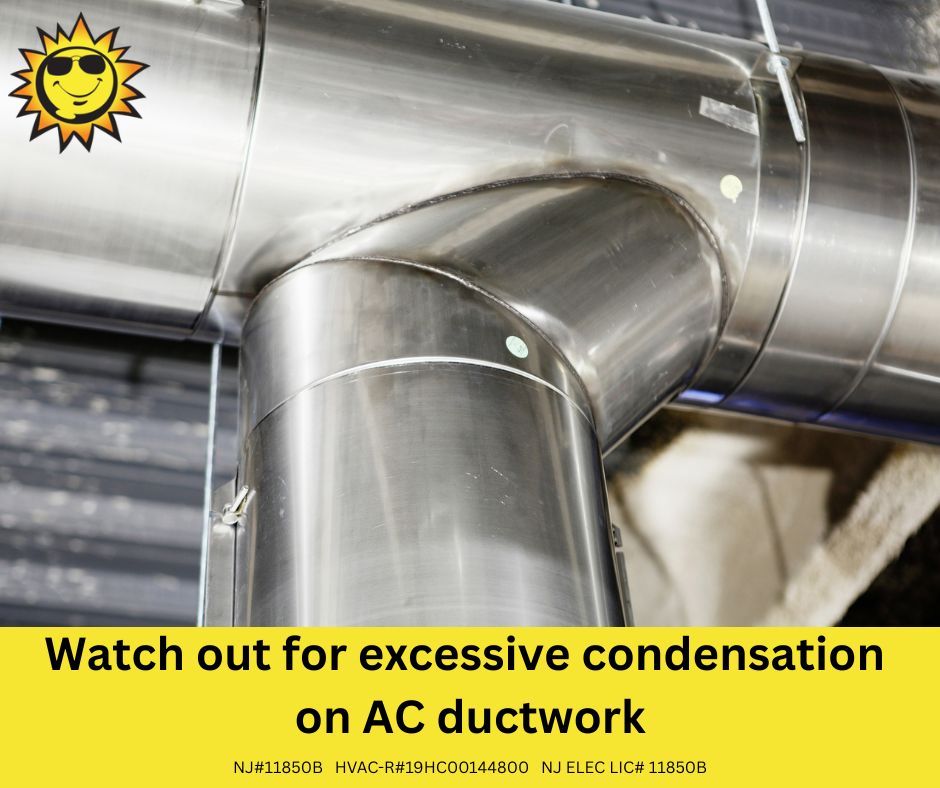 New Jersey is in the midst of a hot summer and the central air conditioning is working full time. A problem that often arises, most commonly in basement ductwork, is condensation.
Where does duct condensation occur?
Condensation usually occurs in the basement ductwork because it does not have to be insulated, since it is in the conditioned envelope of the building. (NOTE: Make sure the attic or crawl space ductwork is insulated and properly ventilated to avoid condensation forming on the ducts there, as the temperature difference is big between the cool air inside the ducts and warm ambient air.)
Why does AC ductwork get condensation?
Condensation collects on the AC ducts because most of the time, the humidity level in basements exceeds 50%, which makes the cooler duct sweat. If you bring a cold glass of water outside on a humid day, you will see the same effect or warm, moist air hitting a cold surface (the ducts).
Homes that have high indoor humidity levels are more likely to experience condensation, especially when the central air conditioning is running. Dirty, clogged filters are another contributing factor, as they impede airflow which causes the AC to work harder—and leads to condensation. And ductwork that lacks sufficient (or any) insulation is exposed to more variable temperatures, which results in condensation. Another factor is an improperly sized HVAC system and the inefficiencies inherent in that problem, which we talked about in last month’s blog article.
Is ductwork condensation harmful?
While a small amount of moisture is normal, you should not see a lot of sweating on the basement ductwork. If you notice this, it means trouble brewing in the HVAC system, including mold growth which leads to unhealthy indoor air. Those airborne mold spores can cause health problems, such as respiratory issues and allergies. And the continuous exposure to moisture, and the ensuing mold and mildew, can end up costing big money in repairs due to damage to the home’s ceilings, walls, and structures around the ducts.
How to combat AC ductwork condensation
There are several ways to mitigate ductwork condensation:
At Bloomfield Cooling, Heating & Electric, we install Aprilaire whole-home dehumidifiers as part of your HVAC ductwork; these can also be installed as a standalone unit. This high-capacity dehumidifier automatically removes the proper amount of moisture from every room throughout the entire house—nearly 12 gallons of water a day—and you never need to empty any buckets, as it drains using a pump. Your Bloomfield Cooling, Heating & Electric technician will check it and clean or replace the filter as needed once a year as part of your maintenance. Read more about the benefits of a whole-home dehumidifier here.
HVAC maintenance is key to system performance
There is a reason why we tell our customers to get fall and spring routine maintenance on their HVAC systems. Preventing condensation is one of them.
Our HVAC technicians will clean condensate lines, change out filters as needed, test airflow, and check the entire system for proper heating in the fall and cooling in the spring. If you notice excessive moisture or water damage around your AC ductwork, suspect mold growth or experience “bad air,” or your system is not working at its best, call Bloomfield Cooling, Heating & Electric at 973.237.0505 for an appointment. If you have a Comfort Club membership, you’ll get priority coverage, repair discounts, and more.


©2026 BloomfieldCooling.com. All Rights Reserved. | Privacy Policy | Sitemap | Powered by Media Consultants, LLC